Choosing the right sewing machine is essential for achieving professional stitching quality, especially when working with garment finishing, knitwear and commercial clothing production. Two machines that often create confusion among beginners and tailoring professionals are overlock and interlock sewing machines.
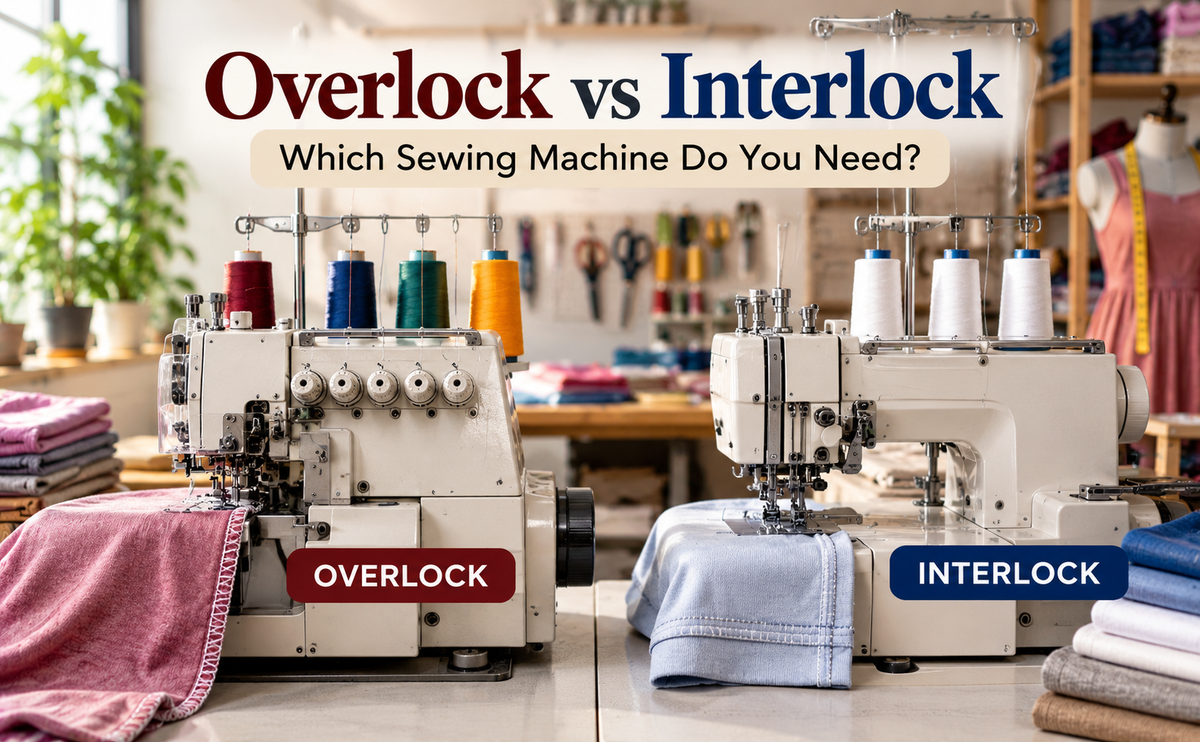
Although both machines are widely used in garment manufacturing, they perform different stitching operations. An overlock sewing machine is primarily designed to join or finish fabric edges, while an interlock sewing machine is commonly used for coverstitch operations such as hemming T-shirts, attaching elastic and finishing stretch garments.
Understanding the difference between overlock and interlock sewing machines can help you select the right equipment for your tailoring shop, boutique or garment manufacturing business.
In this guide, we explain how these machines work, their stitching applications, key differences, advantages and which machine is more suitable for your requirements.
What Is the Difference Between Overlock and Interlock Sewing Machines?
The main difference between an overlock and interlock sewing machine is the type of stitching operation they perform.
An overlock sewing machine is designed to stitch around fabric edges, usually trimming excess material while enclosing the raw edge with thread. This creates a neat finish and helps prevent fraying.
An interlock sewing machine, in the Indian garment industry, commonly refers to equipment used for coverstitch operations. These machines produce parallel stitch lines on one side of the fabric with looper-thread formations underneath, making them particularly useful for hemming knitted and stretch garments.
For example, the side seam of a T-shirt may be joined using an overlock machine, while its bottom hem is commonly finished using an interlock or coverstitch machine.
Overlock vs Interlock Sewing Machine Comparison Table
|
Feature
|
Overlock Sewing Machine
|
Interlock Sewing Machine
|
|
Primary function
|
Joining and finishing fabric edges
|
Hemming, covering and specialized knit finishing
|
|
Stitch formation
|
Threads wrap around fabric edges
|
Parallel needle stitches with looper threads
|
|
Fabric trimming
|
Usually trims excess fabric
|
Typically does not trim fabric
|
|
Common needle setup
|
Usually 1–2 needles
|
Usually 2–3 needles
|
|
Common thread setup
|
Often 3, 4 or 5 threads
|
Varies by machine and covering configuration
|
|
Suitable fabrics
|
Woven and knitted fabrics
|
Primarily knitted and stretch fabrics
|
|
Main applications
|
Edge finishing, seam construction
|
T-shirt hems, sleeve hems, binding
|
|
Stretch capability
|
Suitable stitch configurations can stretch
|
Designed to produce flexible stitches
|
|
Typical users
|
Tailors, boutiques, garment factories
|
Knitwear and activewear manufacturers
|
Both machines are valuable for professional garment production, but they are not interchangeable.
1. What Is an Overlock Sewing Machine?
An overlock sewing machine, also known as a serger, is a specialized machine used to stitch along fabric edges.
Unlike a conventional straight-stitch sewing machine, an overlock machine forms stitches using needle threads and loopers that wrap around the fabric edge.
Most overlock machines also contain trimming knives that remove excess seam allowance as the fabric passes through the machine.
This makes overlocking particularly useful for producing neatly finished garment seams.
Common uses of overlock sewing machines:
- Finishing raw fabric edges
- Joining suitable knitted garment panels
- Preventing fabric edges from fraying
- Finishing blouse and kurti seam allowances
- Constructing T-shirt side seams
- Producing rolled-edge finishes on compatible machines
Overlock machines are commonly used in tailoring shops, boutiques and garment production units.
They are especially useful when a business needs consistent edge finishing across multiple garments.
2. What Is an Interlock Sewing Machine?
An interlock sewing machine is commonly used for specialized knitwear stitching and finishing operations.
In many Indian garment manufacturing environments, the term interlock machine refers to an industrial coverstitch machine. However, terminology varies among manufacturers, so buyers should confirm the exact machine configuration before purchasing.
These machines generally use multiple needles and a looper system to create flexible stitches.
A typical coverstitch produces parallel straight stitch lines on the visible side of a garment, with a looper-thread formation underneath.
This type of stitching is commonly visible along the bottom hems and sleeve hems of ready-made T-shirts.
Common uses of interlock sewing machines:
- T-shirt bottom hemming
- Sleeve hemming
- Knitwear finishing
- Elastic attachment with suitable attachments
- Binding and covering operations
- Sportswear production
- Stretch garment finishing
Interlock machines are particularly useful for garment manufacturers who regularly work with knitted fabrics.
Unlike typical overlock machines, standard coverstitch/interlock equipment does not trim the fabric edge during stitching.
3. Stitch Formation and Seam Appearance
One of the easiest ways to understand the difference between these machines is to examine the stitches they produce.
An overlock stitch wraps thread around a raw fabric edge. The result is a secured edge that helps minimize fraying and can also join garment panels.
An interlock or coverstitch creates parallel lines of stitching on the fabric’s surface. Underneath, a looper thread connects the stitch lines to form a flexible finish.
The two stitches serve different garment construction purposes.
For example, when producing a T-shirt, the overlock machine may be used to join the side seams. The interlock machine is then used to finish the folded bottom hem.
Both operations contribute to the finished garment’s appearance and functionality.
4. Fabric Cutting and Edge Finishing
Overlock machines commonly contain built-in trimming knives.
As the machine stitches, the knife removes excess fabric along the edge. The looper threads then wrap around the newly trimmed edge.
This process can save time during garment production because trimming and edge finishing happen in the same operation.
Interlock machines generally do not contain the same edge-trimming mechanism.
Instead, they stitch over folded hems or designated sections of fabric without cutting away the material.
This difference is important when selecting equipment for a particular sewing operation.
5. Working with Stretch Fabrics
Stretch fabrics are commonly used in T-shirts, leggings, sportswear and casual clothing.
Both overlock and interlock machines can be useful when working with these materials.
Certain overlock stitch configurations provide the flexibility needed for joining knitted garment panels.
Interlock and coverstitch machines are commonly used where garments require flexible hems and covering stitches.
For example, a knitted T-shirt must stretch comfortably around the body without its seams breaking during normal wear.
Choosing the correct stitch type, thread and machine configuration helps achieve the required stretch.
Neither machine should be selected based on fabric stretch alone. The exact sewing operation is equally important.
Applications of Overlock and Interlock Machines in Garment Production
Understanding where these machines are used can help tailoring professionals and business owners make better equipment decisions.
Overlock Sewing Machines for Tailoring Shops
Traditional tailoring shops commonly handle blouse stitching, salwar suits, kurtis, trousers and garment alterations.
Many of these garments contain woven fabrics that require neat seam finishing.
An overlock machine can be useful for finishing raw seam allowances and creating a more professional appearance inside garments.
For tailoring businesses that already own a straight-stitch machine, an overlock machine is often a practical addition.
Interlock Sewing Machines for T-Shirt Manufacturing
T-shirt manufacturing involves several stitching operations.
The garment panels may be joined using an overlock machine, while the bottom and sleeve hems are finished using an interlock or coverstitch machine.
This creates the familiar parallel stitch lines seen on ready-made T-shirts.
Garment manufacturers producing T-shirts regularly may therefore require both machines to complete their stitching workflow.
Overlock and Interlock Machines for Boutique Businesses
Boutiques may work with woven garments, knitted garments and custom fashion designs.
An overlock machine helps finish fabric edges and seams, while an interlock machine may become useful when the boutique begins producing knitwear and stretch garments.
A boutique specializing in traditional woven blouses and kurtis may have greater immediate need for overlocking.
A business producing stretch dresses, leggings or T-shirts may benefit from dedicated coverstitch equipment.
Machines for Sportswear and Activewear Production
Sportswear often uses knitted fabrics designed to stretch during movement.
Appropriate overlock stitch configurations can be used for joining certain garment panels.
Interlock machines help produce flexible hems, covering stitches and other specialized operations.
Some sportswear designs also require true flatseaming machines, which create low-profile seams intended to minimize bulk and friction.
Therefore, sportswear manufacturers should identify each seam requirement rather than assuming an overlock or interlock machine can handle every operation.
Overlock vs Interlock vs Flatlock: Are They the Same?
The terms overlock, interlock and flatlock are sometimes used interchangeably in tailoring shops, but they do not always describe the same stitching operation.
An overlock machine stitches around fabric edges and commonly trims excess material.
An interlock or coverstitch machine typically creates parallel needle stitches connected by looper threads, commonly used for knitwear hemming and covering operations.
A true flatseaming machine produces a low-profile seam used in specialized garments such as sportswear and activewear.
However, the term flatlock is also used informally in India for certain coverstitch and interlock machines.
This can create confusion when purchasing industrial sewing equipment.
Before ordering a machine, ask the seller to demonstrate the exact stitch formation and sewing operation.
For example, if your requirement is to finish T-shirt bottom hems, specifically request a machine suitable for that operation rather than relying on the term “flatlock” alone.
Which Machine Is Better for Your Tailoring or Garment Business?
The better machine depends on the types of garments your business produces.
For Home Tailoring and Garment Alterations
An overlock machine is generally more relevant if you primarily stitch woven garments and need to finish raw fabric edges.
However, overlocking is normally an additional operation rather than a complete replacement for conventional straight stitching.
For regular garment construction, consider a suitable machine such as the Jack F5 Direct Drive Sewing Machine alongside the specialized finishing equipment you need.
For Boutique Businesses
Boutiques producing blouses, kurtis, dresses and custom garments can benefit from an overlock machine to improve seam finishing.
Interlock equipment becomes more relevant when a boutique begins producing knitted garments or requires specialized stretch hems.
For T-Shirt Manufacturing
Businesses manufacturing T-shirts regularly will commonly need both overlock and interlock machines.
The overlock machine performs suitable seam-joining operations, while the interlock machine produces the familiar finished hems.
Using both machines supports a more complete knitwear production workflow.
For Growing Garment Manufacturing Units
Commercial garment production often involves multiple specialized machines.
Depending on the garments being manufactured, a unit may require straight-stitch, overlock, interlock and other industrial sewing equipment.
You can explore industrial sewing machines to understand the equipment options available for professional sewing operations.
The machine setup should always be planned around the actual garment production process.
Important Factors to Consider Before Buying an Overlock or Interlock Machine
Type of Garments You Produce
Identify whether your business primarily handles woven garments, knitted garments or both.
This helps determine which stitching operations are most important.
Number of Needles and Threads
Overlock machines are available in different needle and thread configurations.
Interlock machines also vary according to their stitch formation and intended application.
The right configuration depends on the seam or finishing operation you need to perform.
Fabric Compatibility
Different fabrics require suitable machine settings and sewing components.
Consider the fabrics you work with most frequently and evaluate machine performance using representative samples.
Production Capacity
Your expected daily output should influence your equipment decision.
For a small tailoring shop, the priority may be versatility and reliable finishing.
For a garment manufacturing unit, productivity, consistent stitch formation and compatibility with the production workflow become increasingly important.
Maintenance and Spare Parts
Industrial overlock and interlock machines contain specialized sewing mechanisms that require appropriate maintenance.
Regular cleaning, correct threading, needle selection and manufacturer-recommended servicing help maintain reliable performance.
Before purchasing, enquire about spare parts and suitable service support.
Budget and Business Expansion
Avoid purchasing specialized equipment solely because it is used by larger garment factories.
Start with the operations your business performs most frequently.
As your production requirements grow, additional machines can be introduced to support new garment categories.
Common Mistakes to Avoid When Choosing Overlock and Interlock Sewing Machines
Assuming Both Machines Perform the Same Function
Although both machines can be used in knitwear production, their common stitching applications are different.
An overlock machine cannot automatically replace a coverstitch machine for professional T-shirt hemming.
Buying Without Understanding Stitch Requirements
Machine names alone do not provide enough information.
Identify the type of seam, stitch appearance and fabric application before purchasing.
Ignoring Machine Configuration
Different needle arrangements, thread systems, beds and attachments support different sewing operations.
Select equipment according to the exact work you need to perform.
Expecting One Machine to Complete Every Garment Operation
Garment manufacturing often requires multiple sewing processes.
Straight stitching, overlocking, coverstitching and specialized seam construction may require different machines.
Not Testing the Machine Before Purchasing
Whenever possible, request a demonstration using fabric samples similar to those you use in your business.
Examine stitch appearance, seam flexibility, fabric feeding and the finish produced by the machine.
Where to Buy Overlock and Interlock Sewing Machines in Hyderabad?
Choosing industrial sewing equipment requires an understanding of stitching operations and garment production requirements.
Sri Dhanalakshmi Enterprises is an established sewing machine dealer in Hyderabad, serving customers since 1960. The business provides sewing machine buying guidance for tailoring professionals, boutique owners and commercial garment businesses.
Whether you are setting up a tailoring shop, upgrading your production equipment or expanding into knitwear manufacturing, selecting the appropriate machine type is important.
If you are considering industrial sewing equipment, visit Sri Dhanalakshmi Enterprises in Hyderabad to discuss your stitching requirements and enquire about suitable machine options and availability.
For more guidance on choosing sewing equipment for business use, read our article on the Best Sewing Machine for Tailoring Business in Hyderabad.
Conclusion
The main difference between an overlock and interlock sewing machine lies in their stitching functions and garment applications.
An overlock machine is primarily used for joining and finishing fabric edges, making it useful for tailoring shops, boutiques and garment production units.
An interlock machine, commonly referring to coverstitch equipment in India, is mainly used for flexible hemming, covering and specialized stitching operations on knitted garments.
If your business focuses on woven garments and conventional tailoring, an overlock machine may be the more immediate requirement. If you manufacture T-shirts, sportswear or other knitted garments, an interlock machine may be essential for completing specific finishing operations.
Many professional garment production businesses benefit from using both machines.
For guidance on selecting appropriate sewing equipment in Hyderabad, Sri Dhanalakshmi Enterprises can help you evaluate machine types based on your stitching applications and business requirements.