Choosing the right industrial sewing machine is an important decision for tailoring professionals, garment manufacturers and businesses planning to increase their stitching capacity. Among the different machines used in garment production, single needle and double needle industrial sewing machines are two widely used options.
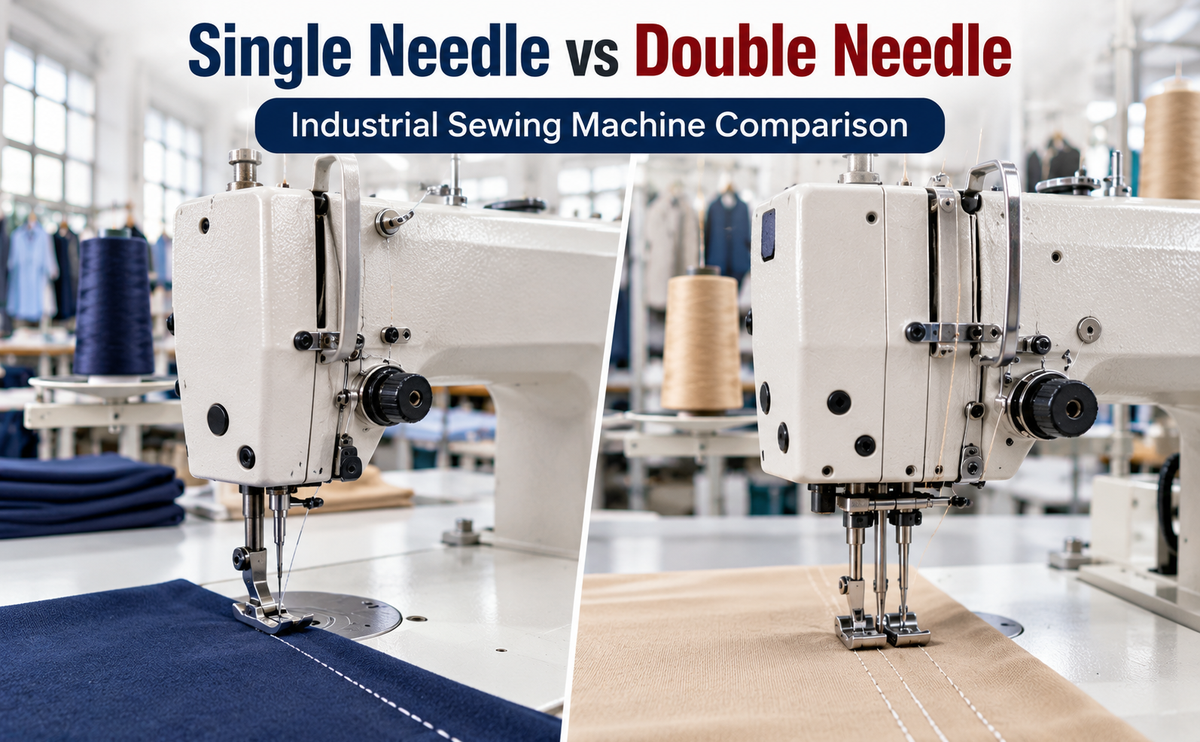
Although both machines are designed for professional stitching operations, they serve different purposes. A single needle industrial sewing machine produces one row of stitching, making it suitable for general garment construction, while a double needle industrial sewing machine produces two parallel rows of stitching simultaneously.
Understanding the single needle vs double needle industrial sewing machine comparison can help you choose equipment that matches your garment types, production requirements and finishing standards.
In this guide, we explain how both machines work, their key differences, common applications, advantages, limitations and the factors to consider before investing in industrial sewing equipment.
What Is the Difference Between Single Needle and Double Needle Industrial Sewing Machines?
The primary difference between single needle and double needle industrial sewing machines is the number of needles used and the stitching patterns they produce.
A single needle industrial sewing machine uses one needle to create a single row of stitching. It is commonly used for joining fabric pieces, garment construction, attaching components and completing standard tailoring operations.
A double needle industrial sewing machine uses two needles to produce two parallel rows of stitching in a single sewing operation. It is particularly useful for decorative topstitching, parallel seam construction and certain reinforcement applications.
Both machines are used in garment factories and professional sewing units, but their suitability depends on the stitching operation.
Single Needle vs Double Needle Sewing Machine Comparison Table
Feature | Single Needle Industrial Machine | Double Needle Industrial Machine |
Number of needles | One | Two |
Stitching output | Single row | Two parallel rows |
Main application | General garment construction | Parallel stitching and topstitching |
Common stitch type | Lockstitch | Twin-row lockstitch |
Thread arrangement | One needle thread and one bobbin thread | Typically two needle threads and two bobbin threads |
Stitch spacing | Single seam line | Set by the needle gauge |
Curves and corners | Generally easier to manoeuvre | May require special techniques or equipment |
Production advantage | Versatility across many operations | Reduces separate passes for parallel stitching |
Typical applications | Shirts, trousers, blouses and dresses | Jeans, shirts, uniforms, bags and decorative seams |
Suitable businesses | Tailoring shops, boutiques and garment factories | Production units needing consistent parallel stitching |
The comparison above refers to conventional industrial lockstitch machines. Other two-needle machines, such as coverstitch and chainstitch equipment, use different stitch-forming mechanisms.
1. What Is a Single Needle Industrial Sewing Machine?
A single needle industrial sewing machine is one of the most commonly used machines in professional garment production.
It generally uses one needle and a bobbin thread to form a lockstitch. The upper needle thread and lower bobbin thread interlock within the fabric to create a secure line of stitching.
Single needle machines are widely used because they can perform many everyday garment construction operations.
Common applications include:
- Stitching shirt and trouser seams
- Blouse and kurti construction
- Attaching pockets
- Stitching collars and cuffs
- Joining garment panels
- Sewing darts and pleats
- Garment alterations
- Straight topstitching
For tailoring professionals handling different garment styles, a single needle machine is usually a fundamental piece of equipment.
The Jack F5 Direct Drive Sewing Machine is an industrial straight-stitch model worth evaluating for regular garment construction requirements.
Single needle machines are available in different configurations, so buyers should choose a model suitable for the material thickness and type of work they perform.
2. What Is a Double Needle Industrial Sewing Machine?
A double needle industrial sewing machine is designed to create two parallel rows of stitches during one sewing operation.
In a conventional double needle lockstitch machine, each needle works with its corresponding bobbin thread to form a separate row of lockstitches.
The distance between the two stitch lines is determined by the machine’s needle gauge and compatible sewing components.
These machines are useful when garments require neat, consistent parallel stitching.
Common applications include:
- Parallel topstitching on shirts
- Decorative stitching on jeans
- Pocket detailing
- Stitching selected waistband designs
- Uniform manufacturing
- Garment panel detailing
- Bag and accessory production
- Upholstery stitching with suitable machine configurations
For example, a garment manufacturer producing trousers with two parallel rows of topstitching can complete that operation using a suitably configured double needle machine.
This avoids the need to stitch the same section twice using a single needle machine.
However, double needle machines are generally more specialized than standard single needle machines.
3. Difference in Stitching Pattern
The most visible difference between these machines is the stitching pattern.
A single needle machine forms one continuous row of stitches along the fabric.
A double needle machine creates two parallel stitch lines simultaneously.
This difference matters when manufacturers need uniform spacing between stitches.
With a single needle machine, an operator can create two parallel rows by sewing the first line, repositioning the fabric and stitching the second line.
However, maintaining identical spacing throughout the operation requires skill and attention.
A double needle machine is designed to maintain a consistent distance between the two rows according to its needle gauge.
This makes it valuable for garments requiring a uniform double-stitch appearance.
4. Difference in Sewing Speed and Production Efficiency
Industrial sewing machines are commonly selected for their ability to support regular production work.
However, machine speed should not be confused with overall production efficiency.
A single needle machine may be suitable for completing a wide range of garment construction tasks without requiring multiple specialized setups.
A double needle machine becomes more efficient when the same operation repeatedly requires two parallel stitch lines.
Instead of sewing the fabric twice, the operator can produce both lines in one pass.
This can reduce handling time and improve consistency in suitable operations.
However, the actual productivity advantage depends on fabric feeding, machine speed, operator skill, seam length and garment design.
A double needle machine is not automatically faster for every sewing task.
5. Difference in Fabric Handling
Both single needle and double needle industrial sewing machines are available in configurations intended for different materials.
Some machines are designed for lightweight garment fabrics, while others are built for thicker materials such as denim, canvas, leather or upholstery fabrics.
The number of needles alone does not determine a machine’s ability to handle heavy fabric.
Fabric handling depends on factors such as:
- Machine construction
- Needle system and needle size
- Feed mechanism
- Presser foot arrangement
- Thread compatibility
- Fabric thickness
- Motor and machine configuration
For example, an industrial single needle machine intended for heavier materials may perform better on layered denim than a double needle machine designed for lightweight garments.
Always select equipment according to the manufacturer’s intended application.
6. Difference in Stitching Curves and Corners
Single needle machines are generally more flexible when sewing garment sections involving curves, corners and frequent changes in direction.
Because they form one stitch line, operators can more easily pivot the fabric around the needle.
Double needle machines require additional consideration when stitching corners because the two needle positions follow different paths during a turn.
Some advanced double needle machines include needle-bar disengagement mechanisms that allow one needle to stop while the other continues sewing. This can help operators produce neat corner stitching.
However, this feature is not available on every double needle machine.
If your business regularly produces detailed garments with curved seams or complex corners, examine the machine’s stitching controls before purchasing.
Advantages and Disadvantages of Single Needle Industrial Sewing Machines
Single needle industrial machines are widely used because of their versatility and suitability for everyday garment construction.
Advantages of Single Needle Sewing Machines
Versatile garment construction: A single needle machine can perform many essential sewing operations, including seams, darts, pocket attachment and general topstitching.
Suitable for different businesses: It is useful for tailoring shops, boutiques, uniform manufacturers and garment production units.
Better control for detailed stitching: Operators can generally handle curves, corners and garment adjustments more conveniently.
Practical first industrial machine: Businesses starting professional garment stitching often benefit from purchasing a suitable single needle machine before adding specialized equipment.
Multiple machine configurations: Different industrial models are available for various fabric weights and production requirements.
Limitations of Single Needle Sewing Machines
A single needle machine cannot produce two separate parallel rows of conventional lockstitch simultaneously.
If a garment design requires double topstitching, the operator generally needs to sew two passes.
This may increase handling time and make consistent stitch spacing more challenging during repetitive production.
However, for general tailoring operations, the flexibility of a single needle machine often outweighs this limitation.
Advantages and Disadvantages of Double Needle Industrial Sewing Machines
Double needle machines are valuable when consistent parallel stitching is an important part of garment production.
Advantages of Double Needle Sewing Machines
Parallel stitching in one operation: Two stitch lines can be produced simultaneously, reducing the need for separate passes.
Consistent stitch spacing: Compatible needle-gauge components help maintain uniform spacing between the two rows.
Professional topstitching appearance: Parallel stitching can improve the visual consistency of shirts, jeans, uniforms and other garments.
Efficient repetitive operations: Businesses completing the same double-stitch operation regularly may benefit from reduced fabric handling.
Specialized production applications: Different machine configurations can support garment manufacturing, bag production and upholstery operations.
Limitations of Double Needle Sewing Machines
Double needle machines may be less convenient for general-purpose tailoring tasks that require only one stitch line.
Their parallel stitching arrangement can also make certain curves and corners more difficult to sew.
Changing stitch-line spacing may require compatible parts or a different needle-gauge configuration.
Some double needle machines offer needle disengagement features, but these should not be assumed to be standard.
For businesses primarily performing single-line garment construction, a double needle machine may not be the most practical first investment.
Which Machine Is Best for Different Garment Manufacturing Businesses?
The ideal machine depends on your main stitching operations rather than the size of your business alone.
1. Tailoring Shops and Alteration Businesses
Tailoring shops commonly handle shirt alterations, blouse stitching, trouser repairs, kurti construction and other custom garment requirements.
A single needle industrial sewing machine is generally more useful for these operations because it supports a broad range of straight-stitching tasks.
Double needle equipment may be added if specific garment designs regularly require parallel stitching.
2. Boutique and Fashion Design Businesses
Boutiques often produce garments requiring different seam shapes, precise fitting and custom detailing.
A single needle machine is usually suitable for the primary construction work.
Double needle machines can be useful for selected decorative or structural topstitching operations, but they are not essential for every boutique.
For businesses beginning professional tailoring, the Jack A2C Automatic Thread Trimming Sewing Machine is another industrial single needle option worth comparing based on production requirements.
3. Shirt Manufacturing Units
Shirt manufacturing involves multiple stitching operations, including joining panels, attaching collars, stitching cuffs and sewing pockets.
Single needle machines perform many of these operations.
Double needle machines may be used where the design requires evenly spaced parallel topstitching.
A production unit handling larger quantities of similar shirt styles may benefit from using both types of machines for different operations.
4. Jeans and Denim Garment Manufacturing
Jeans manufacturing often involves visible topstitching that contributes to garment appearance.
Depending on the design, double needle machines can be useful for creating parallel stitch lines along specific seams and panels.
However, denim production also requires other specialized sewing operations, and the machine must be appropriate for the material thickness.
A double needle machine intended for lightweight fabrics should not automatically be selected for heavy denim.
5. Uniform Manufacturing
Uniform manufacturers often need consistent garment construction and repeatable stitching quality.
Single needle machines can handle standard sewing operations, while double needle machines may be useful for selected topstitching and reinforcement details.
Businesses producing identical uniform designs in larger quantities should evaluate whether dedicated double needle operations would improve workflow efficiency.
6. Bag and Upholstery Manufacturing
Some bags, luggage products and upholstery designs require two parallel rows of stitching.
Double needle industrial machines designed for the relevant materials can improve consistency in these applications.
However, heavy materials may require specialized feeding systems and machine construction.
Choose a machine specifically suited to the product rather than relying only on the number of needles.
Single Needle vs Double Needle: Which Is More Profitable for Garment Production?
Profitability depends on how efficiently a machine supports your production requirements.
A single needle industrial sewing machine can offer strong value because it performs many common garment construction operations.
For a small tailoring shop or boutique, this versatility may be more beneficial than purchasing a specialized machine intended for parallel stitching.
A double needle machine may offer better productivity when a large share of the business involves repeated double-row stitching.
For example, consider a garment order requiring two parallel topstitch lines along the same section.
Using a single needle machine, the operator generally completes one row and then repositions the fabric to sew the second.
With a suitable double needle machine, both rows can be formed during one pass.
This can reduce operation time, although the amount saved will depend on the specific garment and production conditions.
Before investing, compare:
- Number of garments produced daily
- Frequency of parallel stitching operations
- Operator handling time
- Machine purchase and maintenance costs
- Fabric and thread requirements
- Production consistency
- Expected machine utilization
A double needle machine may justify its investment when parallel stitching is a regular production requirement. For mixed tailoring work, a single needle machine may provide greater overall flexibility.
Important Factors to Consider Before Buying an Industrial Sewing Machine
1. Type of Garments You Manufacture
Start by identifying the garments your business produces most frequently.
General tailoring businesses usually require versatile single-line stitching.
Manufacturers producing garments with repeated parallel topstitching may benefit from specialized double needle equipment.
2. Machine Stitch Type
Not every two-needle sewing machine produces the same stitch.
Double needle lockstitch machines, double needle chainstitch machines and coverstitch machines operate differently.
A double needle lockstitch machine generally uses two needles and two bobbins to create two separate rows of lockstitch.
A coverstitch machine uses a different looper-based stitch formation and is commonly used for flexible knitwear hems.
Make sure the machine produces the exact stitch required for your garments.
3. Needle Gauge and Stitch Spacing
Needle gauge refers to the distance between the needles on a double needle machine.
Different garment designs may require different spacing.
Depending on the model, changing the needle gauge may require compatible replacement components.
Buyers should confirm the available gauge options before purchasing.
4. Fabric Feeding Mechanism
Industrial machines use different feeding systems to move fabric through the stitching area.
The correct feeding mechanism can be important when working with slippery fabrics, layered garments or thicker materials.
Evaluate the machine’s feeding performance with representative fabric samples.
5. Automatic Features
Certain industrial machines offer convenience features such as automatic thread trimming, programmable controls or presser foot lifting.
These features may help reduce operator handling during repetitive sewing operations.
However, the available functions vary by model, and not every business requires advanced automation.
6. Maintenance and Service Requirements
Industrial sewing machines require regular maintenance to support consistent operation.
Important considerations include correct lubrication according to manufacturer instructions, cleaning, needle replacement and appropriate thread tension adjustments.
Double needle machines may require additional attention to their two stitch-forming systems.
Access to compatible spare parts and qualified service support should also be considered.
7. Production Expansion Plans
If you are establishing a new garment business, begin with equipment that supports your primary operations.
A single needle machine is often a suitable foundation.
As production expands, specialized machines can be added to improve efficiency in repeated tasks.
You can explore the available industrial sewing machines when evaluating equipment for professional tailoring and garment production.
Common Mistakes to Avoid When Choosing Between Single and Double Needle Machines
Assuming Double Needle Machines Are Always Faster
A double needle machine can reduce sewing passes for parallel stitching, but it does not automatically increase productivity for every garment operation.
If most of your work requires only one stitch line, a single needle machine may be more practical.
Choosing Equipment Without Understanding the Stitch Type
A double needle lockstitch machine is not the same as a two-needle coverstitch machine.
Buyers should identify the required seam appearance and stitch formation before selecting equipment.
Ignoring Needle Gauge Requirements
Parallel stitching must match garment design specifications.
Purchasing a machine with unsuitable needle spacing can limit its usefulness.
Using the Wrong Machine for Heavy Fabrics
Not all industrial machines are designed for thick materials.
Choose equipment according to the manufacturer’s recommended fabric applications and sewing conditions.
Purchasing Specialized Machines Too Early
A new tailoring business may not require dedicated double needle equipment immediately.
Invest first in the machines needed for your most frequent operations and expand your setup when production demand increases.
Where to Buy Industrial Sewing Machines in Hyderabad?
Choosing an industrial sewing machine requires an understanding of garment construction, stitching applications and daily production requirements.
Sri Dhanalakshmi Enterprises is an established sewing machine dealer in Hyderabad, serving customers since 1960. The business offers sewing machines for tailoring professionals, boutique owners and garment manufacturing businesses.
Whether you are purchasing your first industrial sewing machine or upgrading an existing production setup, selecting a model that matches your workload and garment requirements is important.
Visit Sri Dhanalakshmi Enterprises in Hyderabad to enquire about suitable industrial sewing machines and discuss the stitching operations your business needs to perform.
For additional equipment selection guidance, read our article on the Best Sewing Machine for Tailoring Business in Hyderabad.
Conclusion
The choice between a single needle and double needle industrial sewing machine depends on the stitching operations your business performs most frequently.
A single needle machine is generally the more versatile option for everyday garment construction, tailoring, alterations and straight stitching.
A double needle machine is particularly useful when garments require consistent parallel stitching, decorative topstitching or repeated double-row sewing operations.
For small tailoring shops and boutiques, a suitable single needle machine is often the first industrial sewing machine to consider. Manufacturers handling large quantities of garments with parallel stitch requirements may benefit from adding dedicated double needle equipment.
Neither machine is universally better. The right investment depends on your garment designs, production workflow, operator requirements and long-term business plans.
For industrial sewing machine buying guidance in Hyderabad, Sri Dhanalakshmi Enterprises can help you explore suitable equipment for your garment production needs.